• Gardens
  • Find plants
  • Floriade 2022
  • Botanic guardians
  • home
  • about us
  • contact
Nederlands
  Back to results

Black rampion or Black horned rampion

Phyteuma spicatum subsp. nigrum

Bellflower family (Campanulaceae)

Endangered (EN)

Bad at setting seed and few viable young

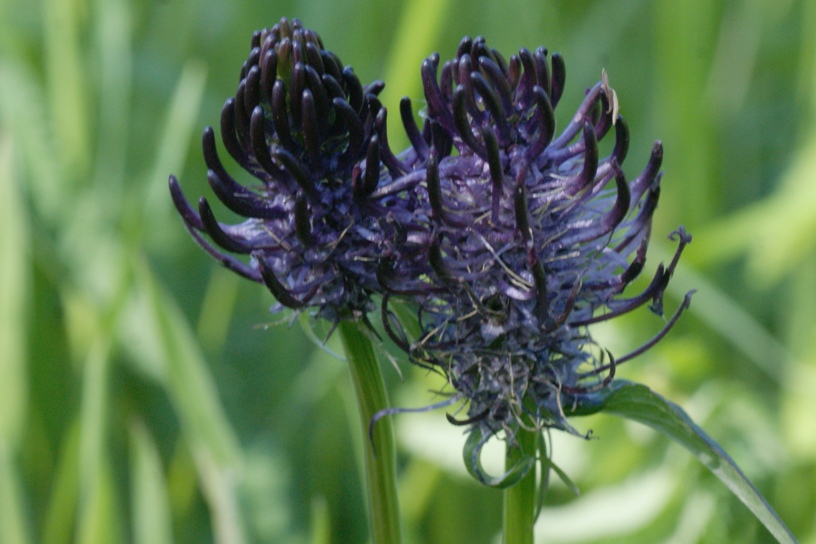
The 30-100 small, dark blue to purple flowers of the blue-black rapunzel, as it is commonly known in Dutch, are densely packed into a 4 cm long, spike-shaped inflorescence. Flowering occurs from late April to early June. Bumblebees visit flowers in search of nectar. Within the inflorescence the flowers open from the bottom up. First the flowers’ own pollen is offered to the pollinator and only when the style is receptive is the flower ready for pollination.

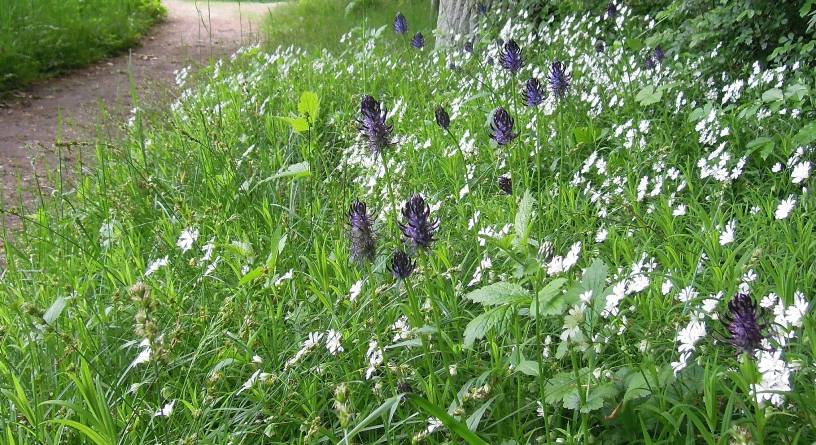
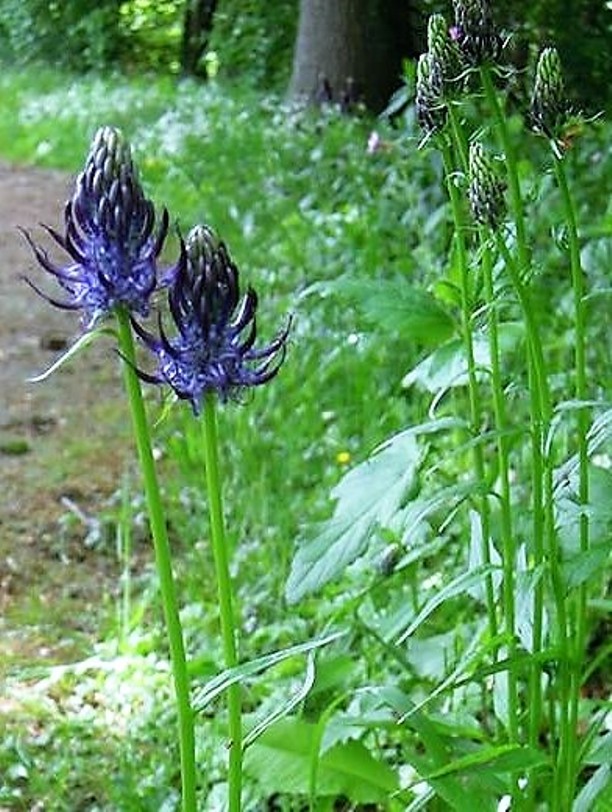
Phyteuma spicatum subsp. nigrum grows in light forests, along shady roadsides and in (late) mown grasslands in the south and east of the Netherlands and has decreased in numbers dramatically. The only sizeable populations can be found in the north of Drente and in South Limburg.

Read more.... »
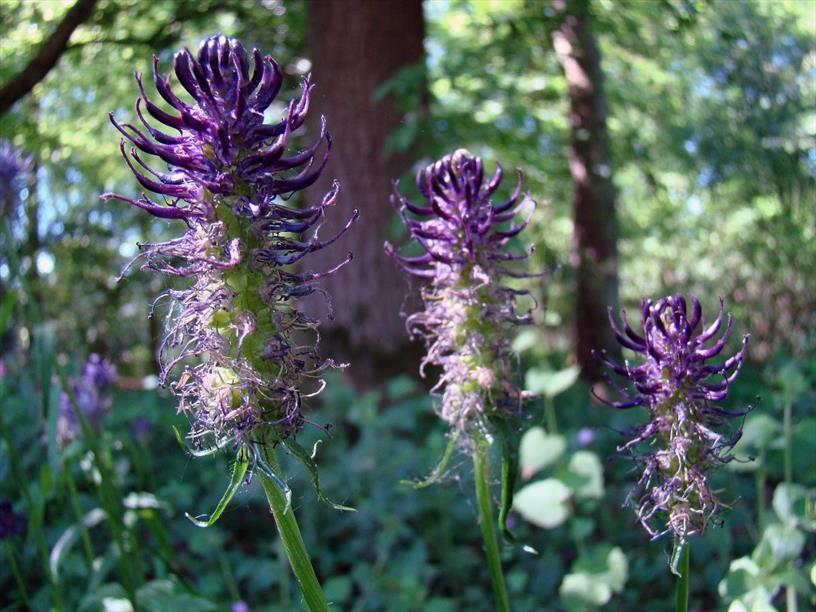
The 30-100 small, dark blue to purple flowers of the blue-black rapunzel, as it is commonly known in Dutch, are densely packed into a 4 cm long, spike-shaped inflorescence. Flowering occurs from late April to early June. Bumblebees visit flowers in search of nectar. Within the inflorescence the flowers open from the bottom up. First the flowers’ own pollen is offered to the pollinator and only when the style is receptive is the flower ready for pollination.

Phyteuma spicatum subsp. nigrum grows in light forests, along shady roadsides and in (late) mown grasslands in the south and east of the Netherlands and has decreased in numbers dramatically. The only sizeable populations can be found in the north of Drente and in South Limburg.

Bad at setting seed and few viable young

Spiked rampion is a plant with attractive, dark blue to purple flower that flowers from the end of May until half June. The single flowers are loosely arranged in spiked inflorescence of about 4 cm high comprising 30 – 100 flowers. Bumblebees visit the flowers for nectar and pollen. The flowers that make up the inflorescence do not bloom all at once but from the base to the top. The pollen in each flower ripens first and only later does the stigma become receptive thus preventing self-fertilisation from taking place.

Ecology and habitat

In the south and east of the Netherlands the spiked rampion occurs in open woods, shady roadside verges and in (late) harvested grassland. This species prefers damp to fairly wet, neither particularly nutrient-poor nor nutrient-rich, weakly acidic to calcareous, humic soils (loam, sand and marls).

Threat

The spiked rampion has undergone a steep decline. Only in the north of Drenthe and in Zuid-Limburg do populations of any size occur. Over the wide distribution elsewhere in the country there are only ever a few individuals found together. Spiked rampion is dependent on cross pollination by bumblebees in order to set seed. These bumblebees transport pollen across distances up to 100 m. In small populations of a few scattered spiked rampions, it can be hard for bumblebees to ensure cross pollination and consequently few seed are set and little rejuvenation can take place. This species do not contribute to the seed bank of long-lived seeds in the soil but individuals can reach considerable age and this way they can hang on in their restricted habitat.

« Description

Present in:

Domies Toen
Hortus Nijmegen
Botanische Tuin Kerkrade
Hortus botanicus Haren / Groningen

Themes

This plant species is widely dependent on pollinators, mainly bumblebees, to aid seed production.

Details

Description: Herb, 20 to 80 cm.
Distributions: Western and central europe to west russia
Habitat: On moist, fairly rich soils in deciduous forests and shaded grassland, on hillsides, in valleys and along ditches.
Year cycle: Perennial (trees and shrubs included)
Flowering period: Mei - juni
Flower color: Blue, purple, black, blue
Notes on flowers: Flowers varying from blackish-violet to blue.
Fruiting period: Juli - augustus
At its best: Mei - juni

Distribution

http://www.verspreidingsatlas.nl/0935

Sources

http://www.floron.nl/publicaties/rode-lijst-2012,
http://www.floravannederland.nl/planten/zwartblauwe_rapunzel/,
http://wilde-planten.nl/zwartblauwe%20rapunzel.htm,
http://www.floron.nl/Portals/1/Plaatjes/Projecten/Stageverslag%20S%C3%A9verine%20Loton%202014.pdf
  Back to results
NVBT
  • Press
  • Contact
  •