• Gardens
  • Find plants
  • Floriade 2022
  • Botanic guardians
  • home
  • about us
  • contact
Nederlands
  Back to results

Common Butterwort

Pinguicula vulgaris

Bladderwort family (Lentibulariaceae)

Endangered (EN)

After a major dip, a slight recovery

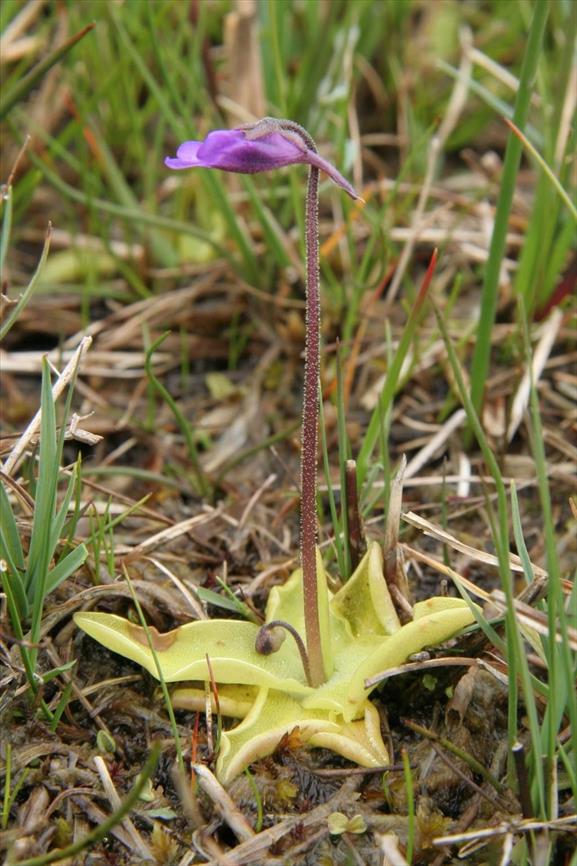
Once this carnivorous plant with its little purple flowers was so common on sandy soils that, in the Netherlands, it was nicknamed viooltje, meaning ‘little violet’, and in English the common butterwort. Now, after a major dip it is beginning to recover. Common butterwort is a plant of nitrogen-poor soils.

In order to obtain the extra nutrients it catches little insects with its leaves. The upper surface of the leaf is covered in glands that produce a sweet, sticky secretion. Insects landing on the leaves become stuck and the leaves slowly roles up. The glands secrete digestive juices that dissolve the nitrogen out of the prey. The common butterwort is known in folk medicine to be a healing plant: one extract is an effective remedy for nervousness.
 
Read more.... »

After a major dip, a slight recovery

Once this carnivorous plant with its little purple flowers was so common on sandy soils that, in the Netherlands, it was nicknamed viooltje, meaning ‘little violet’, and in English the common butterwort. Now, after a major dip it is beginning to recover. Common butterwort is a plant of nitrogen-poor soils.

In order to obtain the extra nutrients it catches little insects with its leaves. The upper surface of the leaf is covered in glands that produce a sweet, sticky secretion. Insects landing on the leaves become stuck and the leaves slowly roles up. The glands secrete digestive juices that dissolve the nitrogen out of the prey. The common butterwort is known in folk medicine to be a healing plant: one extract is an effective remedy for nervousness.

Ecology and habitat

Common butterwort occurs throughout Europe, particularly in mountainous areas. This species is also widely distributed across North America and parts of Asia. Common butterwort was known to be growing in the Netherlands before 1950 especially in the Gelderland Valley, across large parts of Overijssel, Gelderland, De Peel and was locally present in the Drentsche Aa basin. In the Netherlands it grows in open, sunny places on the mildly acidic, nitrogen poor soils of marshy heaths and blue grasslands, especially in stream valleys. Its habitat is often permanently wet. Running groundwater is important for growth because of the dissolved minerals it carries.

Threats

During the last century common butterwort underwent a sharp decline and is now endangered. Reasons include drainage and fertilisation of the wet, heath- and stream valley landscapes as well as a modernisation in agricultural practices. Common bladderwort is currently only found in protected areas. An attempt is being made to conserve the species through regular removing of top soil. In addition, improved groundwater management, important for the common bladderwort, is helping the species. Locally this seems to be working and there is now new hope for the ‘green starfish on the moor’.

 
« Description

Present in:

Hortus Alkmaar
Hortus botanicus Haren / Groningen

Themes

The Botanical Gardens Association cannot take any responsibility for any adverse effects of the use of plants. Always seek the advice of a professional before using any plant medicinally. Always seek the advice of a professional before using any plant medicinally.

The common butterwort is known to be a healing plant in traditional medicine: one extract is an effective remedy for nervousness.

The plant can be used to curdle milk. The milk is poured over a strainer on which fresh leaves of butterwort have been laid. The milk is then left for a day or two until it sours and becomes solid like yoghurt and is considered to be delicious. A small quantity of the milk can be kept to inoculate further batches. Another report says that the leaves should be infused in the milk for some time.

Details

Description: Carnivorous plant, up to 0.15 m.
Distributions: Europe, north america and parts of asia
Habitat: In open, sunny places on the mildly acidic, nitrogen-poor soils of marshy heathland and cirsio dissecti-molinietum grassland association, especially in stream valleys, its habitat is often permanently wet, with running groundwater.
Year cycle: Perennial (trees and shrubs included)
Hardiness: Colder than -4 f (very hardy)
Flowering period: Mei - juni
Flower color: Purple, white

Distribution

http://www.verspreidingsatlas.nl/0942

Sources

http://www.floron.nl/publicaties/rode-lijst-2012,
http://www.pfaf.org/user/Plant.aspx?LatinName=Pinguicula+vulgaris
  Back to results
NVBT
  • Press
  • Contact
  •