• Gardens
  • Find plants
  • Floriade 2022
  • Botanic guardians
  • home
  • about us
  • contact
Nederlands
  Back to results

Madder

Rubia tinctorum

Madder family (Rubiaceae)

Regionally Extinct (RE)

Source of the deep red dye, alizarin

Dyer’s madder is a perennial plant native to Anatolia (Turkey). The plant has rhizomes that grow to 1 meter deep underground. From these rhizomes a red dye is extracted: Turkish red. Ever since the Middle Ages, dyer’s madder has been cultivated on the clayey soils of Zeeland and South Holland.

In autumn roots of three-year old dyer’s madder plants were dug up and stored in a specific type of incubator where the plants were dried and finally crushed.

In 1826 scientists first extracted alizarin, the active dye in dyer’s madder. In 1868 after the German chemists, Graebe and Liebermann, discovered how alizarin could be extracted from coal tar, the dyer’s madder industry collapsed.

Read more.... »
Source of the deep red dye, alizarin

Dyer’s madder is a perennial plant native to Anatolia (Turkey). The plant has rhizomes that grow to 1 meter deep underground. From these rhizomes a red dye is extracted: Turkish red. Ever since the Middle Ages, dyer’s madder has been cultivated on the clayey soils of Zeeland and South Holland.

In autumn roots of three-year old dyer’s madder plants were dug up and stored in a specific type of incubator where the plants were dried and finally crushed.

In 1826 scientists first extracted alizarin, the active dye in dyer’s madder. In 1868 after the German chemists, Graebe and Liebermann, discovered how alizarin could be extracted from coal tar, the dyer’s madder industry collapsed.

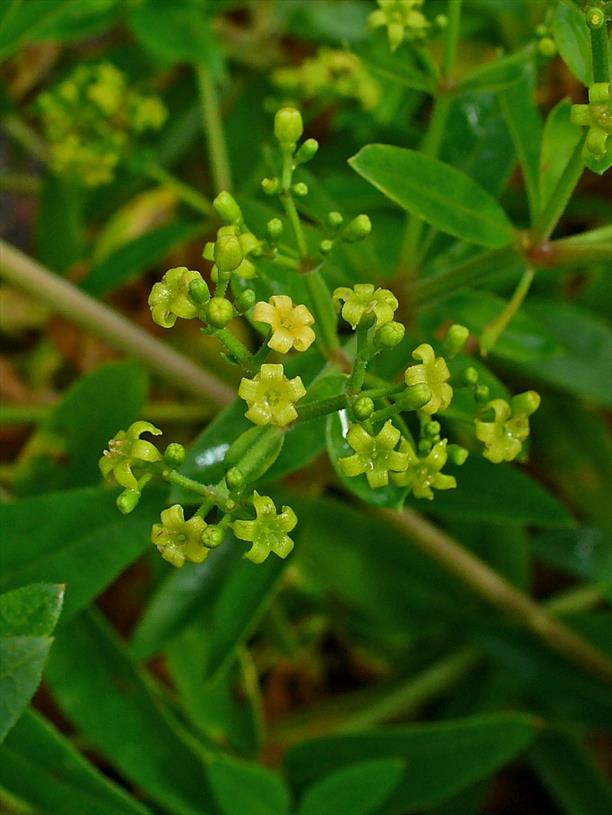
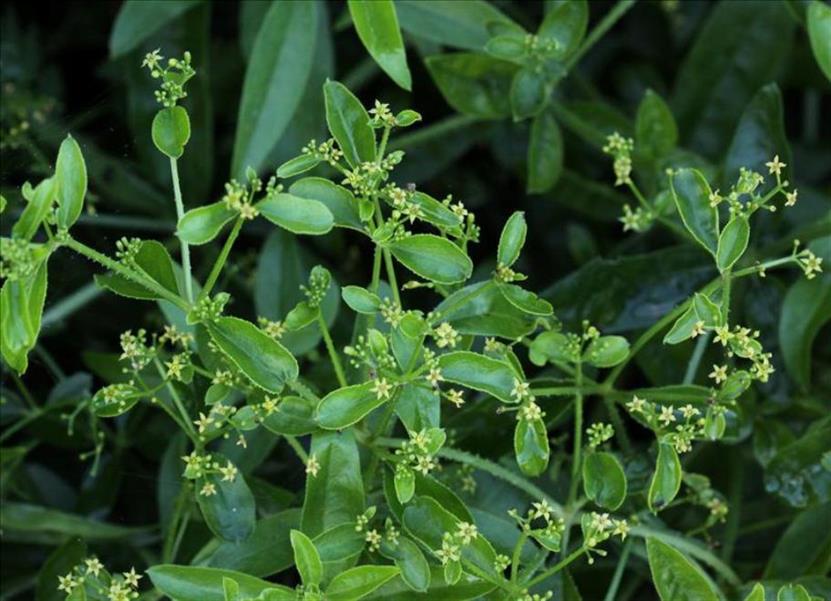
Dyer’s madder is just like any other madder - a rather ordinary weed that is able, thanks to its small spines on its stem, to climb up through the vegetation. The inflorescence is modest, yellowy green and splayed. The plant was once cultivated for the red pigment extracted from its roots having originated from the eastern Mediterranean.

It is also referred to as mee or mede in Dutch meaning ‘mead’, and is still known by its nickname krabben (meaning ‘scratch’) by the local people of Bergen op Zoom where Dyer’s madder used to be cultivated. The scientific name is more understandable: rubia comes from the Latin ruber meaning red, tincotrum means paint. The rhizome contains the light-fast and deep red pigment, alizarin.

Around 1870 a synthetic preparation was discovered and madder went out of use. Since the madder pigment is so resistant to light, the Netherlands ended up with the colours in their flag. Initially the colours were orange-white-blue. The orange dye was made from mixing madder red with yellow dyes, named weld, derived from gualda.

These yellow pigments are not light-fast and thus the orange eventually changed to red; the red stripe remains to this day. Being very Dutch and pragmatic the colour shift in the flag was adapted and the true Orange-enthusiasts now use an orange pennant.

This species was already being cultivated in the Middle Ages and was used for numerous ailments such as rheumatism and gout, period pains, wounds and ulcers. Then it was discovered that it is also carcinogenic, the medicinal use of Dyer’s madder was prohibited.

Ecology and habitat

Dyer’s madder prefers sunny to semi shady sites, not too dry, on relatively calcium rich clay soils.

Threat

As a relict from a previous agricultural practice, madder grew along roads, dykes and in hedges in the Delta region and the Betuwe. Although it has recently been found in a single hedge in Kamperland in Noord-Beveland, this species has all but disappeared from the Netherlands without so much as a flag wave.

« Description

Present in:

Hortus Botanicus Amsterdam
Hortus Alkmaar
Botanische Tuinen Universiteit Utrecht
Botanische Tuin De Kruidhof
Nederlands Openluchtmuseum

Themes

Crown jewel in the De Kruidhof Botanic Garden.

Around 1870 a synthetic preparation (pigment) was discovered for the colour red and madder went out of favour. The Dutch flag ended up the colours it is today because the madder pigment is so resistant to light: when the colours were initially mixed they were orange-white-blue. The orange dye was made from mixing madder red with yellow dyes derived from dyer's rocket (Reseda) but these yellow pigments are not light-fast and thus the orange eventually changed to red; the red stripe remains to this day. Being very Dutch and pragmatic the colour shift in the flag was adopted and true Orange-enthusiasts now use an orange pennant or streamer.

Dyer’s madder was once cultivated for the red pigment extracted from its roots. The scientific name is reflects this with 'rubia' originating from the Latin 'ruber' meaning red and 'tincotrum' meaning paint. The rhizome contains the light-fast and deep red pigment, alizarin.

When it was discovered that the plant was carcinogenic, the medicinal use of Dyer’s madder was prohibited.

Details

Description: Herb, up to 0.60 m.
Distributions: Eastern mediterranean, turkey, caucasus
Habitat: On neglected ground, in hedgerows and amongst rubble.
Year cycle: Perennial (polycarpic evergreen)
Hardiness: -4 - 5 f (hardy - very cold winter)
Flowering period: Juni - juli
Flower color: Yellow, green
Fruiting period: September

Distribution

http://www.verspreidingsatlas.nl/1088

Sources

http://www.floron.nl/publicaties/rode-lijst-2012,
http://www.pfaf.org/user/Plant.aspx?LatinName=Rubia+tinctorum,
Floron 2012 Basisrapport, IUCNredlist.org
  Back to results
NVBT
  • Press
  • Contact
  •