White Willow
Salix alba
Willow family (Salicaceae)
 Least Concern (LC)




Fast and flexible
Willows are pioneer plants that grow along rivers in wet sand or gravel. Its botanical name, Salix, is derived from the Celtic word sal meaning ‘near’ and lis meaning ‘water’. Since willow grows rapidly and has deep roots, it is often planted to help prevent erosion of riverbanks. Stick a willow twig in the ground in the spring and before long it will have sprouted.
Willows are an important pollen producer for insects in particular a number of different types of solitary bees are dependent on the willow flowers. The bark of the willow contains salicylic acid, the base constituent of aspirin. Pitted white willow (i.e. cut and stored in water until bud break in spring) produces willow rods used for weaving baskets, facings and gabions for embankment construction.
Themes
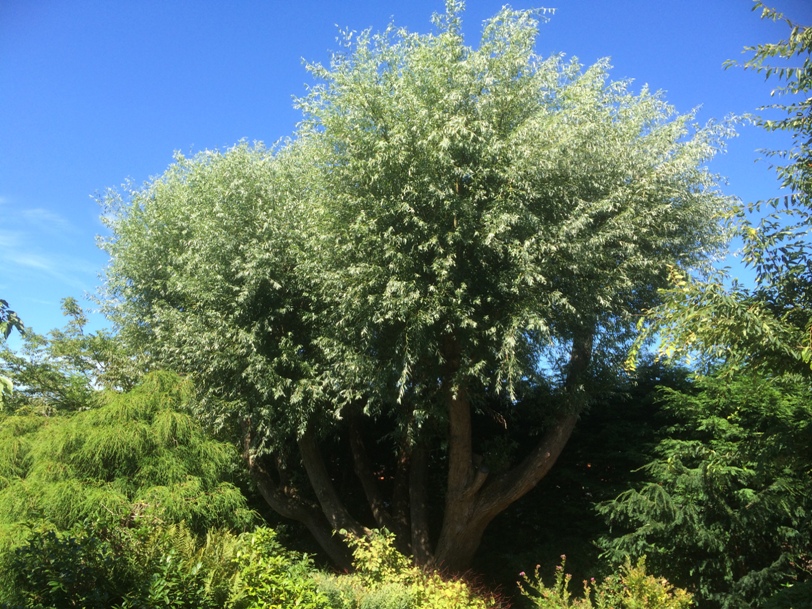
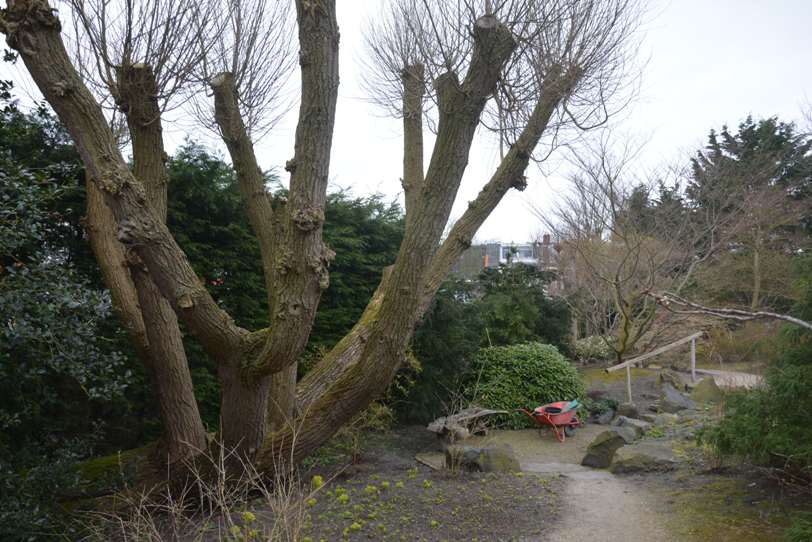
Crown jewel in the Overzee Botanic Garden.
An imposing seven-stemmed willow in 'Hortus Overzee', the Japanese garden in Den Helder.
The bark contains salicylic acid, which eases aches and pains and reduces fever.
In Japanese folklaw the willow is associated with ghosts.
Details
| Description: | Tree, shrub, 6 - 20 m. |
|---|---|
| Distributions: | Europe except in the north. also in northwestern africa and eastwards to central asia. introduced elsewhere. |
| Habitat: | Along rivers and in foodplain forests |
| Year cycle: | Perennial (polycarpic decidous) |
| Hardiness: | -4 - 5 f (hardy - very cold winter) |
| Flowering period: | April - mei |
| Flower color: | Yellow, green |
| Notes on flowers: | Mannelijk katje geel en langwerpig 5 cm, gelijk met het blad. vrouwelijk katje groen en eveneens langwerpig, 5 cm. |
| Fruiting period: | Juni - juli |
| Fruit color: | Green |
| Notes on fruits: | Groen flesvormige doosvrucht met harige zaadjes (zomersneeuw). |
| At its best: | April - juli |