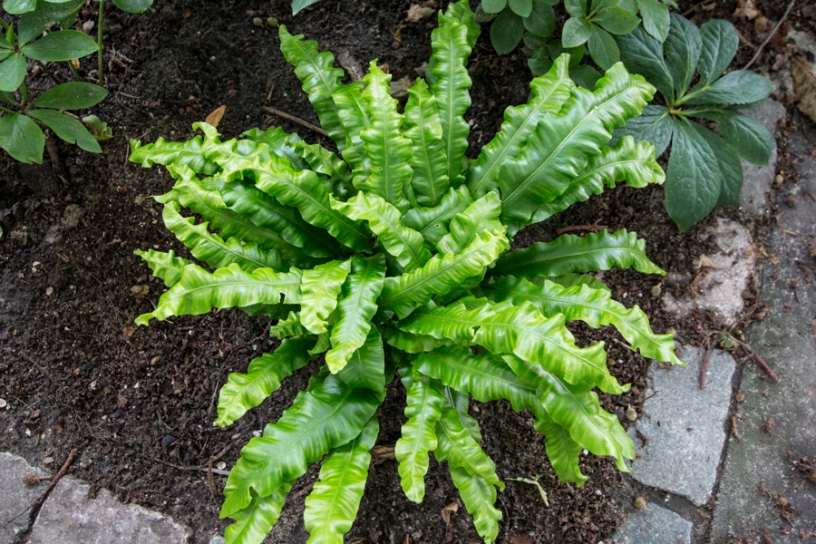
Hart's-tongue
Asplenium scolopendrium
Spleenwort family (Aspleniaceae)
 Least Concern (LC)



A poison for beautiful eyes
During the Italian Renaissance this plant was very popular with ladies of the nobility, known as belladonnas. At this time shiny, dilated pupils were perceived as a mark of beauty. Ladies going to an evening ball would put a few drops of the juice from the glossy black berries into their eyes and did not mind the resulting impaired vision.
Their pupils dilated through the action of the substance atropine found in deadly nightshade. Today ophthalmologists make use of this effect when undertaking a full examination of the eye. The substance is extremely toxic and is present in all parts of the plant.
Read more.... »

Themes
The hart's-tongue fern is used externally as an ointment in the treatment of piles, burns and scalds. An infusion is taken internally for the treatment of diarrhoea, bladder- and kidney stones, and for removing obstructions in the liver and spleen.
FLORON declared 2015 the year of the wall plants. The Dutch 'wall flora' contains a number of rare and protected species. An important part of this flora comprises ferns such as members of the Aspleniaceae e.g. green spleenwort, northern spleenwort, rustyback fern, hart's tongue fern, maidenhair spleenwort and black spleenwort. The rare wall flora also includes ornamental escapes such as the wallflower, yellow corydalis, Hieracium amplexicaule and ivy-leafed toadflax. As well as the wall plants themselves, the seedbank and the sporebank for these species are also threatened. These banks are essential for the wider distribution of wall plants.
FLORON declared 2015 the year of the wall plants. The Dutch 'wall flora' contains a number of rare and protected species. An important part of this flora comprises ferns such as members of the Aspleniaceae e.g. green spleenwort, northern spleenwort, rustyback fern, hart's tongue fern, maidenhair spleenwort and black spleenwort. The rare wall flora also includes ornamental escapes such as the wallflower, yellow corydalis, Hieracium amplexicaule and ivy-leafed toadflax. As well as the wall plants themselves, the seedbank and the sporebank for these species are also threatened. These banks are essential for the wider distribution of wall plants.
Details
| Description: | Herb, evergreen fern up to 0.60 m. |
|---|---|
| Distributions: | Atlas region of morocco across to the caspian sea, and in japan and north america. can also be found in the netherlands. |
| Habitat: | Old walls, sides of ditches, basalt slopes, forests, under thickets and on dead wood. |
| Year cycle: | Perennial (trees and shrubs included) |
| Hardiness: | -4 - 5 f (hardy - very cold winter) |
| Flower color: | Not applicable |
| Fruiting period: | Juli - augustus |
| At its best: | Mei |
Sources
http://www.floron.nl/publicaties/rode-lijst-2012,https://www.rhs.org.uk/Plants/25910/i-Asplenium-scolopendrium-i/Details,
http://www.pfaf.org/user/Plant.aspx?LatinName=Asplenium+scolopendrium,
De complete gids voor tuinvarens - Martin Rickard