Indian Horse-chestnut
Aesculus indica
Soapberry family (Sapindaceae)





Flower candles from the Himalayas
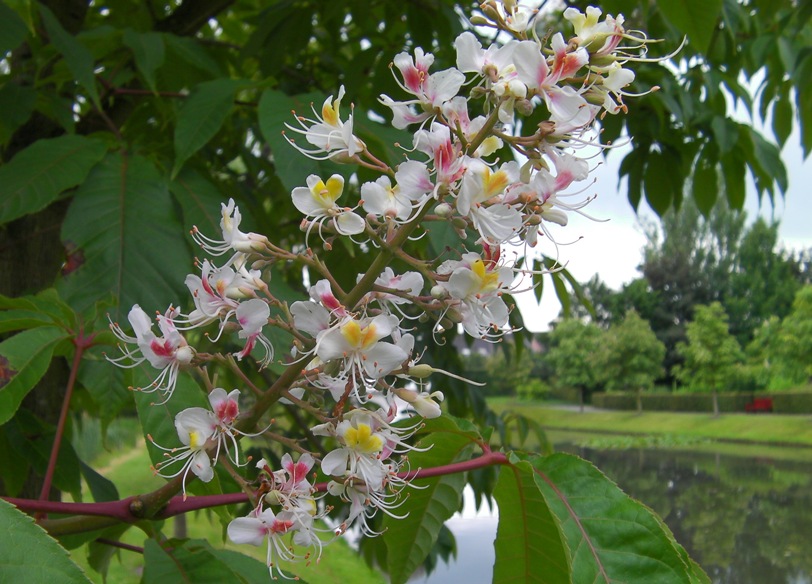
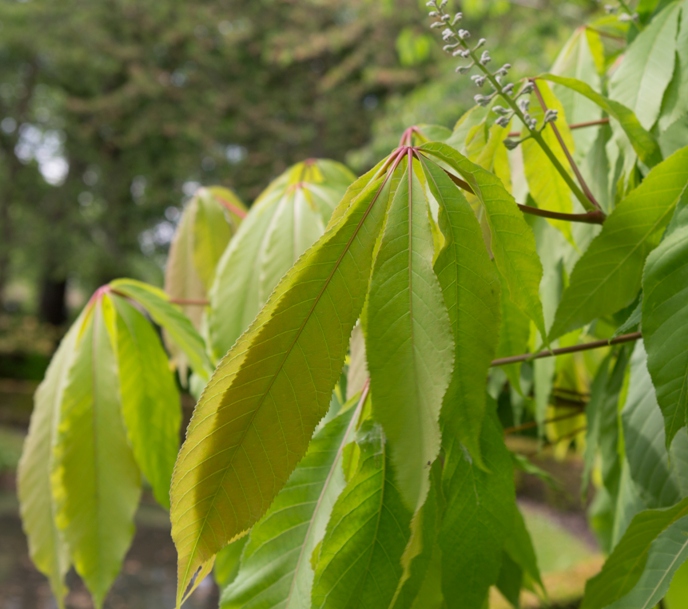
This species is native to the mountains of northeast Afghanistan, Pakistan, Kashmir and west Nepal. Here in Europe it is an attractive tree of up to 30 m in height growing in parks and requiring full sun. The smooth, grey bark is striking but turns rough and flaky in older trees. The overwintering buds are sticky. In June, when the tree is in full leaf, the flowers open. The individual flowers, which make up the inflorescence (the 'candles' that consist of many flowers), are white with a yellow spot and turn to pink with long, gracefully protruding stamens. The husk, containing the conker, resembles a small pear. The seed, or conker, is larger and darker brown in colour than the common horse chestnut.
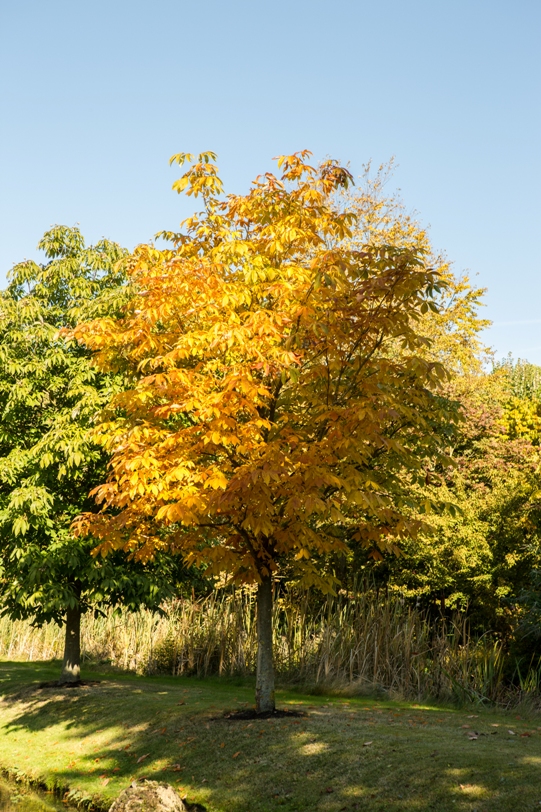
In India, soap is made from cooking the seeds after having removed the seed coat because the seeds are rich in saponin, a soapy substance. Before the leaves are shed in autumn they turn a beautiful yellow colour. Indian horse chestnut is not frost hardy, especially when young. This species can be just as stately and monumental in habit as the common horse chestnut. The light white wood of the Indian horse chestnut was once used to make tea chests.
Read more.... »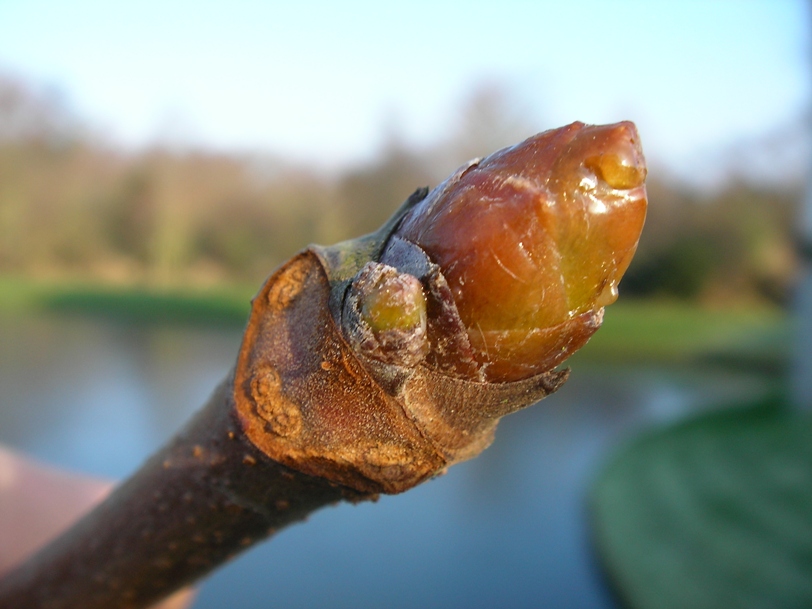
Themes
Crown jewel in the Botanic Garden Arboretum Oudenbosch.
All parts of the tree contain aesculin, which is toxic as it destroys red blood cells.
The white, light wood of the Indian horse chestnut was used for many years to make tea chests in India. The chestnut is also used as a soap for washing - the seed coat is removed and the seeds are first cooked to release the saponin (a soap-like substance).
For seeds to be used for consumption, they need to be ground, soaked in water and rinsed for 5-7 days to remove the bitter poison. Then they are dried and ground into flour.
Indische paardenkastanje (Indian Horse-Chestnut) werd in 1851 ingevoerd in Engeland door Kolonel Henry Bunbury.
Details
| Description: | Tree, on average taller than 12 m |
|---|---|
| Distributions: | Himalayas |
| Habitat: | Forest trees, between 1200 - 2700 m altitude on damp sites near water courses |
| Year cycle: | Perennial (polycarpic decidous) |
| Hardiness: | 5 - 14 f (hardy - cold winter) |
| Flowering period: | Juni - juli |
| Flower color: | White |
| Notes on flowers: | White flowers with a yellow to orangey-red spot. |
| Fruiting period: | September - november |
| Fruit color: | Various colours |
| Notes on fruits: | Husk, light green, beige; seed, chestnut brown |
| At its best: | Mei - juli |
Sources
www.kew.org/science-conservation/plants-fungi/aesculus-indica,Indian Journal of Traditional Knowledge. Vol. 8(2), April 2009, pp. 285-286. Ethnobotany of Indian horse chestnut (Aesculus indica) in Mandi district,
http://nopr.niscair.res.in/bitstream/,
Hort.ufl.edu/database/documents/pdf/tree_fact_sheets/aesinda.pdf, en.wikipedia.org, Dendrologie van de lage landen - Jan de Koning en Wim van den Broek, Dendroflora 34: pag. 13