• Gardens
  • Find plants
  • Floriade 2022
  • Botanic guardians
  • home
  • about us
  • contact
Nederlands
  Back to results

Dracaena floribunda

Dracaena floribunda

Asparagus family (Asparagaceae)

Endangered

The exuberant dragon

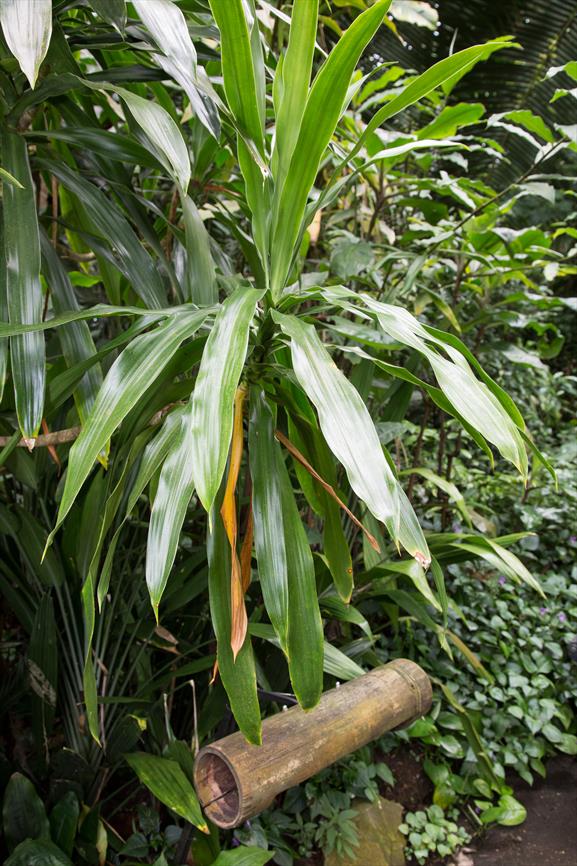
Originally this plant grew on the Mascarene Islands - an archipelago east of Madagascar - to which Mauritius and Réunion belong. Today this plant is difficult to find in the wild. Moreover in botanical gardens it is a rarity, as only rarely does it reproduce successfully. Dracaena floribunda looks like a tree, it flowers with abundant plumes comprising clusters of thousands of white to yellow flowers resulting in pendulous inflorescences. The crown consists of whorls of thick, green to red leaves. These whorls are grouped into 'floating' rosettes on top of a bare trunk.

It is a relative of the Dracaena draco, the Canary Island dragon tree, known for its red sap that was believed to be dragon's blood.

Read more.... »
The exuberant dragon

Originally this plant grew on the Mascarene Islands - an archipelago east of Madagascar - to which Mauritius and Réunion belong. Today this plant is difficult to find in the wild. Moreover in botanical gardens it is a rarity, as only rarely does it reproduce successfully. Dracaena floribunda looks like a tree, it flowers with abundant plumes comprising clusters of thousands of white to yellow flowers resulting in pendulous inflorescences. The crown consists of whorls of thick, green to red leaves. These whorls are grouped into 'floating' rosettes on top of a bare trunk.

It is a relative of the Dracaena draco, the Canary Island dragon tree, known for its red sap that was believed to be dragon's blood.

On Mauritius and Mahe

The genus Dracaena comprises more that 100 species, including Dracaena draco the well known dragon tree from the Canary Islands. With Dracaena floribunda the long, pendulant, branched inflorescences are its most remarkable feature. They are more than 1 m in length and comprise 15 – 20 cylindrical bunches. The species name floribunda (profuse) reflects the abundant inflorescences bearing strongly perfumed, white flowers. Dracaena floribunda can reach the size of a small tree. According to Kew Gardens it is ‘one of the largest and most striking of all known Dracaenas’.

Ecology and habitat

Most Dracaena species occur on mainland Africa and the islands to the east lying in the Indian Ocean. Dracaena floribunda is found on Mauritius, an island some 1800 km to the east of the African continent that together with the islands of Rodrigues and Réunion form the Mascarene Islands. It is also found on Mahe, one of the islands of the Seychelles archipelago also lying in the Indian Ocean. On Mauritius and Mahe this small tree grows above 300 m in humid tropical forests.

Threat

Dracaena floribunda is a component of the ‘relict forest’ of Mauritius and Mahe. The species appears to only grow above 300 m but this distribution might simply reflect the fact that this forest type now only grows at this altitude. It is not known how many plants there are left in the wild but on both islands there is not much forest remaining and the number of Dracaena floribunda will be limited. Although there are a few in national parks, it is debateable as to whether there is enough to keep the species viable. Disappearance of the humid tropical forest still remains a threat. There are hardly present in any collections of botanic gardens.

« Description

Present in:

Koninklijke Burgers' Zoo

Themes

Crown jewel of Royal Burgers' Zoo.

The strong perfume of the flowers indicates that insects are the pollinators attracted to this flower.

The species name 'floribunda' (profuse) reflects the abundant inflorescences bearing strongly perfumed, white flowers.

Details

Description: Tree, up to 2.5 m.
Distributions: Mauritius
Habitat: Humid tropical forests, above 300 m in altitude.
Year cycle: Perennial (polycarpic evergreen)
Hardiness: Warmer than 59 f (heated glasshouse - tropical)
Flower color: White
Notes on flowers: This dragon tree has a distinctive inflorescence, which bears strongly perfumed white flowers.

Sources

http://www.iucnredlist.org/details/30529/0
  Back to results
NVBT
  • Press
  • Contact
  •