Chestnut Dioon
Dioon edule
Cycad family (Zamiaceae)
 Vulnerable





A spry old man from Mexico
The Mexican arrowroot cycad is native to Central America but can be found planted across many frost-free regions. Cycads are among the oldest seed plants - they had evolved before the dinosaurs. They have, despite their appearance and their Dutch name the ‘palm fern’ family, nothing to do with real palm trees. The Mexican arrowroot cycad grows in very dry places where fires are a regular occurrence. Although the mature plants are able to survive these conditions, the young plants are less able to do so.
The Mexican arrowroot cycad exists in symbiosis with cyanobacteria that lives in its roots and helps the cycad by capturing nitrogen from the atmosphere. In this way the Mexican arrowroot cycad contributes to the nutrient balance of the ecosystem in which it lives. Through habitat loss and over collecting, the number of these plants in the wild has declined sharply.


Themes
Crown jewel in the Utrecht Botanic Gardens.
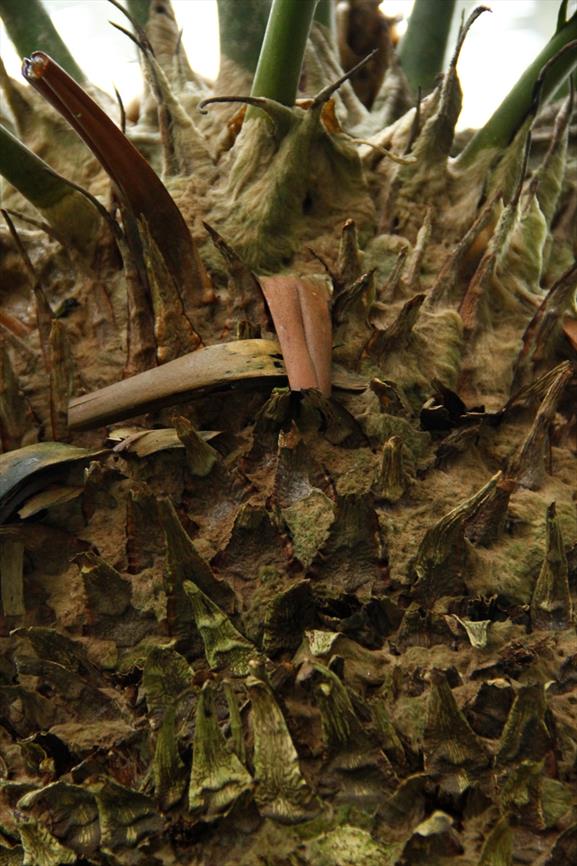
Dioon edule can survive very harsh conditions and through selective adaptation in response to these harsh climates, it has developed a vigorous tap root for anchorage and water conduction.
Sago is recovered from the starchy seeds, but care must be taken in the preparation of this because all the cycads contain toxic substances (neurotoxins).
All cycads contain toxic substances (neurotoxins).
The leaves (fronds) of this cycad are used for decoration, especially in religious ceremonies.
Details
| Description: | Shrub, cycad up to 3.5 m. |
|---|---|
| Distributions: | East coast of mexico |
| Habitat: | Tropical deciduous thorny brush vegetation and oak woodlands, 500 -1500 m in altitude. |
| Year cycle: | Perennial (trees and shrubs included) |
| Hardiness: | 5 - 14 f (hardy - cold winter) |
| Flower color: | Brown, grey |
| Notes on flowers: | This plant has no flowers because it belongs to the gymnosperms instead it produces brownish grey cones during flowering; male cones are a soft brown, 15-40 cm long, 6-10 cm diameter; female cones ae a soft grey, 20-35 cm long, 12-20 cm in diameter. |