Saffron Crocus
Crocus sativus
Iris family (Iridaceae)

Red gold
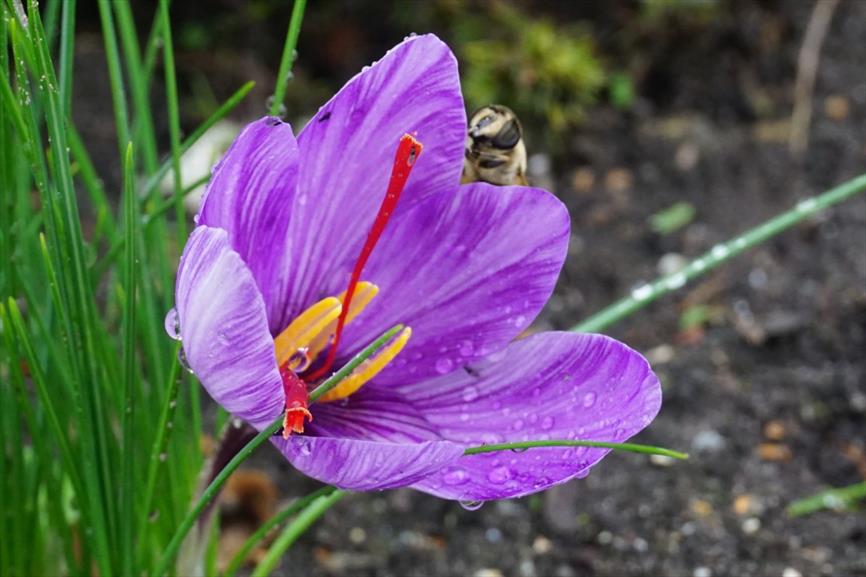
The autumn crocus is not found in the wild. This small, purple flowering, bulbous plant is a cultivar that has a long history of being grown around the Mediterranean and across the Arab world. It is from the flowers of the autumn crocus that saffron is derived. Saffron is a powerful flavouring commonly used in Arabic cuisine and adds a dark, honey-like taste to dishes. Saffron is also a strong pigment providing a deep yellow or red colour.
In the autumn the red pistils in the flowers are harvested by hand. They are then dried and sometimes crushed. This labour-intensive work makes saffron very expensive and thus richly deserves its nickname, ‘red gold’. Ninety percent of saffron comes from Iran.
Themes
Crown jewel of Holland Open Air Museum.
Stigmas are removed from the flowers, dried and then stored in air-tight containers for later use as saffron in cooking however only a very small quanitiy is derived from a large amount of flowers. Saffron is a prized ingredient in a number of classic dishes including risotto, rice, paella and bouillabaisse.
Saffron is characterized by a bitter taste and an iodoform or hay-like fragrance.
Saffron is used in tradional medicine. Experts believe saffron was first documented in the 7th century BC in an Assyrian botanical reference compiled under the last Assyrian ruler, Ashurbanipal. Since then, the documentation of the use of saffron over the span of 4000 years in the treatments of some 90 illnesses has been uncovered. In view of its wide range of medical uses, the saffron has undergone extensive phytochemical and biochemical studies and a variety of biologically active ingredients has been isolated.
Details
| Description: | Bulbous or tuberous plant, up to 7-15 cm |
|---|---|
| Distributions: | Cultivated. native habitat unknown. |
| Habitat: | Full sun to partial shade. |
| Year cycle: | Flowers only once (monocarpic) |
| Hardiness: | 14 - 23 f (hardy - average winter) |
| Flowering period: | Oktober - februari |
| Flower color: | Purple |
| Notes on flowers: | Cup-like, lilac-purple flowers; each flower has three long styles each tipped with a reddish-orange stigma. |
| At its best: | September - oktober |