Rough Horsetail
Equisetum hyemale
Horsetail family (Equisetaceae)
 Least Concern (LC)




The Lego plant that is a good diuretic
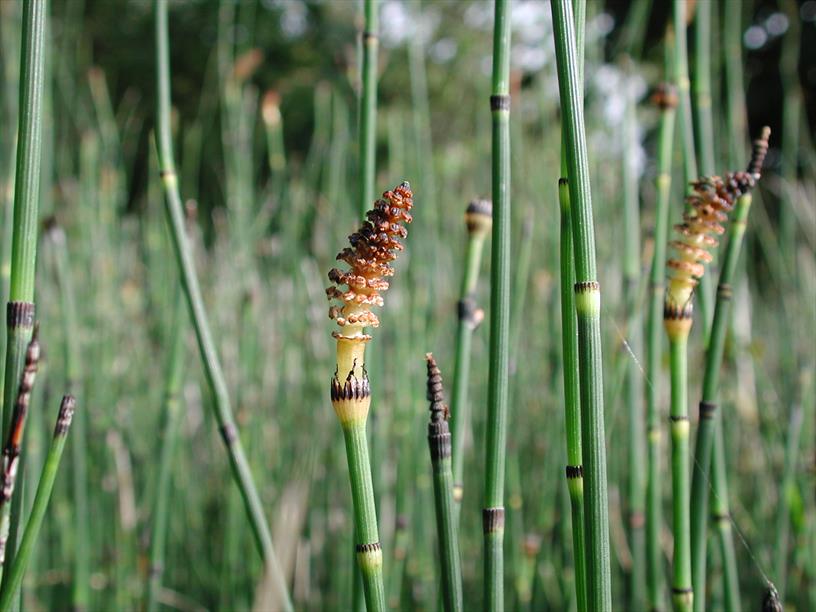
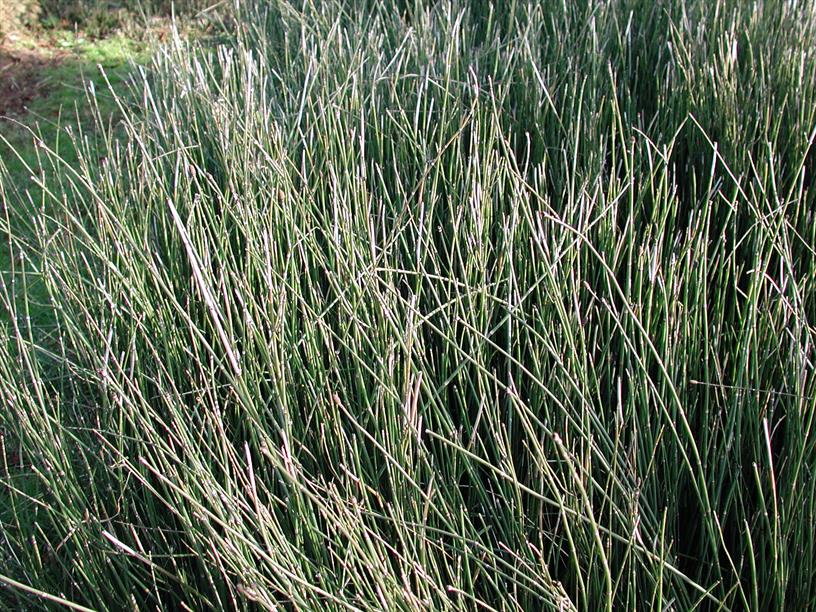
Rough horsetail is quite rare in the Netherlands. The hollow, dark green stems resemble straw when it dries out. The stem is ribbed and rough and because of this roughness it was once used as a natural scourer. The small leaves are borne as a cuff-like whorl pressed flat against the stem. Dutch children also call it the 'lego-plant' as the stem consists of separate pieces that fit together to form a tower.
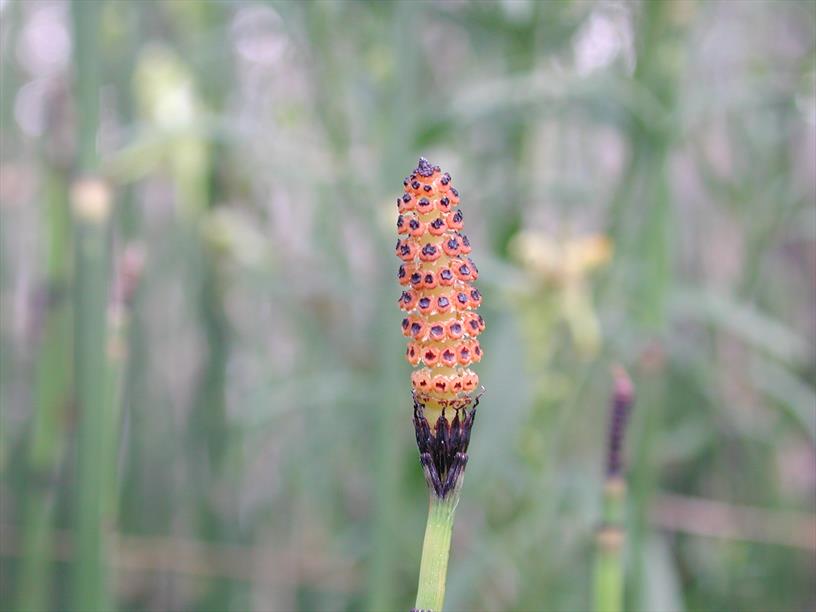
The horsetail is a spore bearing plant without flowers belonging to the genus Equisetum. The name Equisetum is derived from equum meaning horse and seta meaning tail. The spore bearing, cone-like spikes appear in mid summer. Horsetail can spread easily by way of its rhizomes.
The Roman, Pliny, mentioned the diuretic effect of the horsetail, which is used in, amongst other things, homeopathy.
Themes
Crown jewel in the Alkmaar Botanic Garden.
Equisetum hyemale is used in homeopathy to treat bladder complaints.
Stems are very rich in silica and are used for scouring and polishing metal and as a fine sandpaper. The hollow stems have been used as whistles.
A light pink dye is obtained from the stem.
Details
| Description: | Herb, up to 0.90 m, with hollow, jointed stems, tiny scale-like leaves borne in whirls, and terminal cone-like aggregations of spore-bearing sacs (sporangia). |
|---|---|
| Distributions: | Eurasia, north america |
| Habitat: | Forests and river banks; 100-3000 m altitude. |
| Year cycle: | Perennial (trees and shrubs included) |
| Hardiness: | Colder than -4 f (very hardy) |
| Flower color: | Not applicable |
| Notes on fruits: | Spores. the strobilus is to ovoid with a pointed end and is enveloped by the upper leaf wreath at its base. |