Caoutchouc Tree
Hevea brasiliensis
Spurge family (Euphorbiaceae)


An early example of biopiracy
Until the 19th century the rubber tree was only known from the Amazon rainforest. The tapping of the milky sap (latex) from these, and other plants, had been going on for thousands of years. The material was moulded into balls and used in ball games.
During the Industrial Revolution rubber became a sought after material in Western countries. One consequence of this was an increase in the local prosperity of Amazonia. The capital, Manaus, was nicknamed the ‘Paris of the Tropics’. This prosperity left once the seeds were smuggled out of the country and the colonial powers of England and the Netherlands set up large rubber plantations in Southeast Asia.
High demand for rubber arose after the invention of the car, coupled with a vulcanisation process that cured the rubber making it tougher and more wear resistant. Natural rubber, along with synthetic substitutes, remains an important commercial product today.

Themes
Crown jewel in the Botanical Garden TU Delft.
Hevea brasiliensis is of major economic importance because the milky latex extracted from the tree is the primary source of natural rubber.
Details
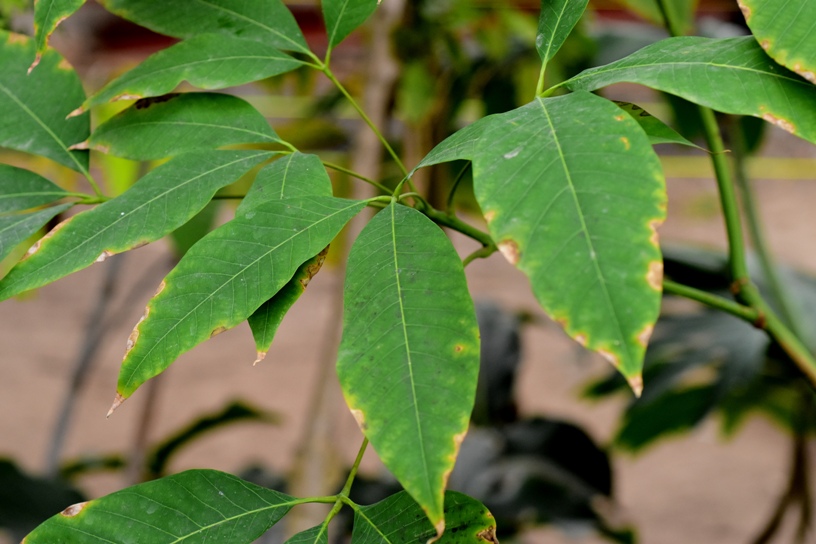
| Description: | Tree, typically 30-40 m tall, although usually 15-25 m in cultivation, with a leafy crown. the trunk is cylindrical but frequently swollen towards the base. the outer bark is pale to dark brown with a smooth surface and the inner bark is pale brown with abundant white or cream coloured latex. |
|---|---|
| Distributions: | Native to brazil (parts of the amazon basin and matto grosso) and the guianas but most of the world's rubber comes from plantations in indonesia, thailand and malaysia. |
| Habitat: | Humid lowland tropics between 6ºn and 6ºs. |
| Year cycle: | Perennial (polycarpic decidous) |
| Hardiness: | 41 - 50 f (heated glasshouse - warm termperate) |
| Flowering period: | Juni - juli |
| Flower color: | Yellow |
| Notes on flowers: | The flowers are small with no petals, bright or cream-yellow in colour and extremely pungent; they are either male or female with both found in the same inflorescence. |
| Fruiting period: | Augustus - september |
| Notes on fruits: | The fruit is an exploding 3-lobed capsule. |