Sweet Cicely
Myrrhis odorata
Carrot family (Apiaceae)
 Least Concern (LC)




Lovely to have in the kitchen
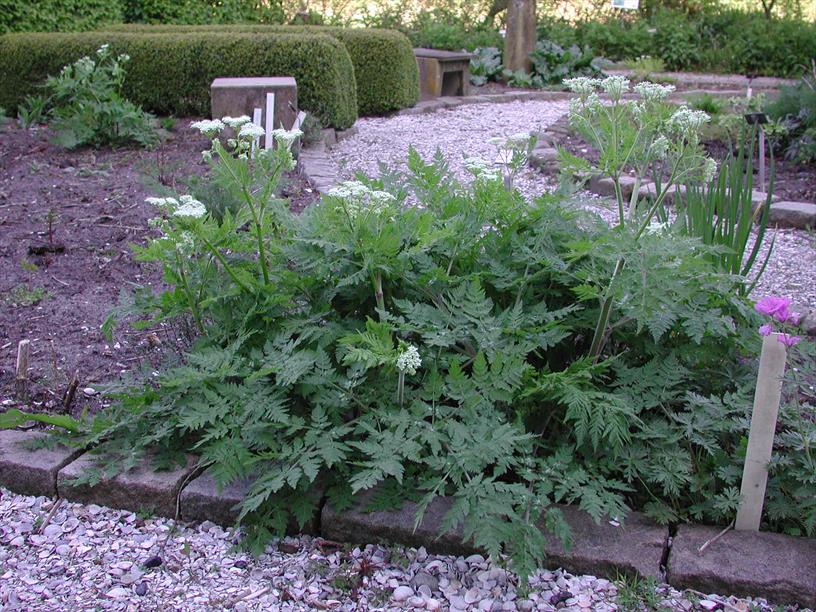
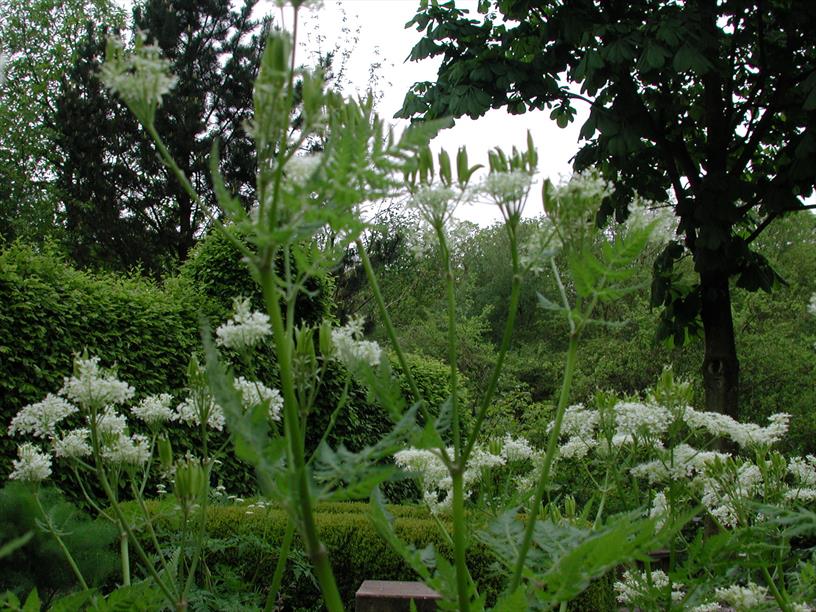
Sweet cicely originates from the Pyrenees to the Caucasus and grows wild across the whole of Europe. The plant can grow up to 120 cm and the fern-like, pale green leaves appear very early in the spring. The umbel shaped flowers appear in early May.
If a leaf is delicately bruised, it emits a sweet aniseed-like smell. The leaves and roots can be eaten as vegetables (an old Dutch name for the vegetable is kruudmoes). The seeds are often used as a herb in pickles and also as an ingredient in many liqueurs. No kitchen garden should therefore be without sweet cicely for its taste and fragrance. Above all else it is much loved by bees and butterflies.
Themes
Crown jewel in the Alkmaar Botanic Garden.
Sweet cicely is an excellent aid for honey bees. It gives a delicious taste to honey. The flowers are sweet and attracts not only bees but also other pollinating insects.
The leaf and seeds are used as a culinary herb.
The name of this plant is derived from the Greek 'myrrha' meaning 'scented balm' and 'orodata' meaning 'fragrant'. The leaves when rubbed release an aniseed-like aroma.
Details
| Description: | Herb, 0.60-1.2 m, with 2- to 3-pinnate leaves. |
|---|---|
| Distributions: | Europe |
| Habitat: | Shady roadside verges, forest margins and hedgerows; often near habitation. |
| Year cycle: | Perennial (polycarpic decidous) |
| Hardiness: | 5 - 14 f (hardy - cold winter) |
| Flowering period: | Mei - juni |
| Flower color: | White |
| Notes on flowers: | White flowers borne in umbels with 4-20 ray florets. |
| Fruit color: | Brown |
| Notes on fruits: | Glossy dark brown schizocarp, 1.5-2.5 cm long. |
| At its best: | Mei - juni |